An Anti-ICE Protester Is Serving 50 Years. Now She Says the Government Is Making an Example of Her.
AUGUST 25, 2026 | CUP OF CULTURE
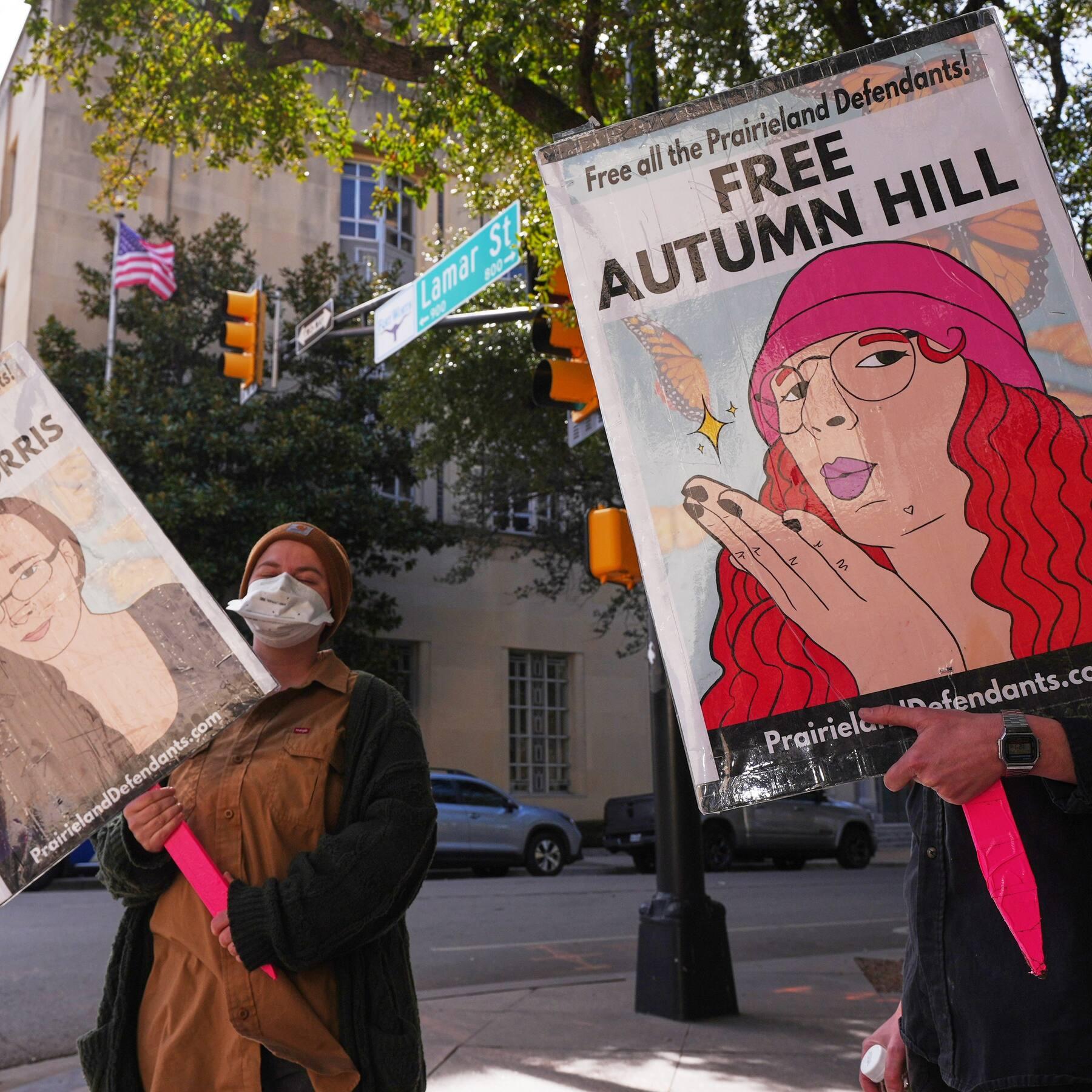
A case that should be setting off alarms across the country is getting nowhere near the attention it deserves.
Autumn Hill, a 30-year-old activist convicted in connection with a July 4, 2025 protest outside the Prairieland ICE detention facility in Alvarado, Texas, is serving a 50-year federal prison sentence.
Now, speaking from behind bars, Hill says she believes the punishment is about something much bigger than what happened outside that detention center.
“I’m absolutely being imprisoned for a political agenda,” Hill told Democracy Now! in an interview published Tuesday.
And the details surrounding this case deserve national attention.
What happened at Prairieland
On July 4, 2025, demonstrators gathered outside the Prairieland Detention Center to protest ICE and show solidarity with immigrants detained inside.
The demonstration ultimately became violent.
Fireworks were set off. Property was vandalized. And when law enforcement responded, an officer was shot and wounded.
Benjamin Song was convicted of attempted murder in connection with that shooting and ultimately sentenced to 100 years in prison.
Those facts matter. Political violence should not be erased or minimized simply because we are concerned about the government's response.
But what happened to several of the other defendants raises a very different question.
How far can the government stretch responsibility for one person's violence across an entire group of political protesters?
Autumn Hill received 50 years
Hill says she did not intend for the demonstration to become violent and says she had already left before the officer was shot.
Her attorney similarly argued at sentencing that there was no evidence Hill possessed a gun or believed violence was an appropriate way to achieve political change.
Nevertheless, Hill was convicted of charges including rioting, providing material support to terrorists and explosives-related offenses connected to fireworks.
Her sentence:
50 years.
She will be approximately 80 years old when that sentence ends.
Hill is now arguing that the extraordinary punishment was intended to accomplish something beyond incarcerating the people involved that night.
She believes it was meant to send a message.
Then there is Daniel Sanchez-Estrada
Perhaps the most disturbing example of how far this prosecution extended is Daniel Sanchez-Estrada.
He wasn't at the Prairieland protest.
His attorney said he wasn't involved in planning it.
Sanchez-Estrada was convicted of charges related to concealing documents after moving a box containing artwork, journals and antifascist publications following the demonstration.
He received 30 years in federal prison.
Thirty years.
For someone who wasn't even at the protest.
That should make every person concerned about political speech and association pay attention.
The government called them an “antifa cell”
Federal prosecutors portrayed the defendants as members of a North Texas “antifa cell” and described what happened at Prairieland as domestic terrorism.
The Justice Department has celebrated the convictions as evidence that people it describes as antifa terrorists will receive severe punishment.
But civil-liberties advocates and attorneys have warned that the government's theory in this case could extend much further than Prairieland.
Antifa isn't a conventional organization with a centralized national leadership structure or membership rolls.
That creates an enormous question:
What exactly does someone have to do before the federal government decides they are part of an “antifa” terrorist operation?
And once that label is applied, how much political activity can become evidence against them?
This is bigger than one protest
That is why Cup of Culture believes the Prairieland case deserves substantially more national scrutiny.
You do not have to defend everything that occurred outside the detention center to recognize the danger here.
An officer was shot. That is serious.
People accused of committing violence can be prosecuted for the violence they actually committed.
But accountability for individual criminal conduct and assigning collective terrorism liability across a political protest are not the same thing.
When one defendant receives 50 years despite saying she had left before the shooting, and another receives 30 years despite never attending the demonstration, we should be asking extremely difficult questions about where criminal accountability ends and political punishment begins.
Because precedents don't stay confined to the people we agree or disagree with.
Once the government develops a legal framework capable of treating political association, literature, protest activity and the actions of other people as components of a terrorism case, that framework exists for future administrations to use too.
“They are going to bury you”
Hill believes that's precisely the point.
Speaking from prison, she described the case as a warning to people who resist the Trump administration, law enforcement and mass immigrant detention.
Whether appellate courts ultimately agree with the government's theory remains to be seen. Hill and other defendants have indicated they intend to challenge their convictions and sentences.
But they are already serving decades behind bars.
And America should not wait until another protester receives a decades-long terrorism sentence before deciding this deserves attention.
The Prairieland case isn't merely a story about what happened outside an ICE detention center in Texas.
It's a story about how the United States government defines terrorism.
It's about how political ideology can enter a criminal prosecution.
It's about the boundaries between individual responsibility and guilt by association.
And ultimately, it's about how much power we are willing to give the government to decide when political dissent becomes a national-security threat.
That conversation needs to happen now.