SCOTUS Delivers Surprise Ruling on Mail-In Voting Regulations Ahead of Midterms
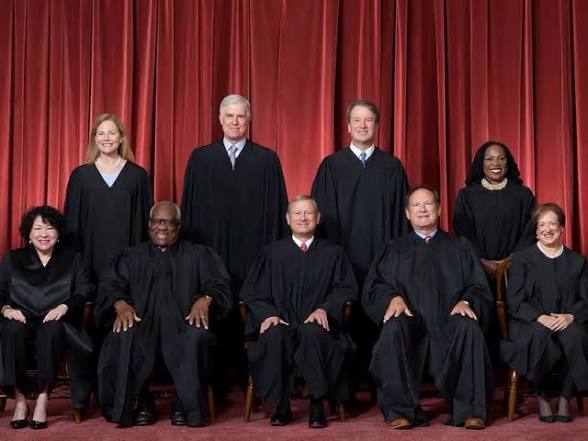
This week, The Supreme Court of the United States (SCOTUS) issued a ruling that can be described as nothing short of a miracle after the long list of wins the highest court has given to Trump. In the case 26A305 Postal Service v. California, in a 7 to 2 decision, the court ruled that the United States Postal Service regulations regarding mail-in ballots could not move forward.
On March 31st, 2026, Trump issued Executive Order 14399, titled “Ensuring Citizenship Verification and Integrity in Federal Elections,” that required all federal agencies to implement rules regarding election oversight.
The USPS, in return, created extremely stringent guidelines for ballot envelopes that would be accepted. This included sizing, branding, and barcoding. It also would be rejecting a group of ballots if only one of them failed the inspections that would be necessary to fulfill these guidelines. The USPS would dispose of these ballots as it does other “undesirable" mail.
The Legal Battle
A group of 23 states, led by California, and the District of Columbia went to federal court in Massachusetts to challenge the government’s efforts to implement the executive order. On June 25th, U.S. District Judge Indira Talwani, issued a preliminary injunction finding that the USPS overstepped its legal authority by attempting to restrict and regulate mail-in voting procedures ahead of the midterms.
On August 24th, SCOTUS put her injunction on hold, allowing the Trump administration to begin implementing the executive order. The majority explained that the states’ challenge had come too soon because the order had not yet been carried out – and, therefore, the states had not suffered the kind of injury that would allow their lawsuit to go forward.
Three days later, Talwani issued a new temporary restraining order (TRO) that prohibited the Trump administration, for 14 days, from imposing requirements for the design of the envelopes used to mail ballots and for the submission of voter data into a USPS portal. The Trump administration returned to SCOTUS to request relief from the order, though Solicitor General D. John Sauer withdrew it three days later when Talwani issued a more narrow preliminary injunction to replace her TRO.
"The Postal Service’s final rule imposes only modest envelope-design and addressee-information requirements for federal-election ballots sent via U.S. Mail.”
— Solicitor General D. John Sauer
The filing by Sauer argued that Talwani's rationale was “simplistic" and “baseless". He wrote, “the Postal Service’s final rule imposes only modest envelope-design and addressee-information requirements for federal-election ballots sent via U.S. Mail.” He continued that without a stay, states will be able to mail out ballots that do not comply with this order.
Multiple states, including California, argued that the “unprecedented experiment" by USPS was unlawful and suggested that a stay could lead to “chaos” with some states unable to comply by the November election. They added “even if state and local officials were somehow able to implement the new rule perfectly, there is a high risk of technical breakdown, ineptitude, and delay on the part of USPS.”
How the Justices Ruled
The Majority Opinion
The majority decision was written by Justice Katanji Brown-Jackson, citing that the federal government's argument was unlikely to win on the merits, meaning that they likely do not have the factual basis, evidentiary support, or legal arguments to win in front of the court. Justice Jackson also cited that there were not “equitable factors" to support granting the stay. This means that there was no proof that allowing the USPS regulations to move forward would fix a harm (to the government). They also weighed what damage this would cause to the parties represented by the plaintiff, in this case the individuals represented by the states that brought the lawsuit.
Justice Jackson wrote on behalf of herself, Barrett, Gorsuch, Sotomayor, Kagan, and Chief Justice Roberts.
Kavanaugh’s Concurrence
Justice Kavanaugh agreed that the injunction from the lower court should remain in place however, he wrote a separate concurrence that emphasized that applying these rules prior to the 2026 Midterm Election would violate the Administrative Procedure Act. The APA acts as a “constitution" of sorts to define the rules and regulations for federal agencies with regard to transparency. Kavanaugh was putting emphasis that implementing this regulation change at the current moment would fail to keep USPS transparent by failing to allow for feedback or data collection prior to rollout. In doing so, Kavanaugh appears to signal to the government that while the timing is incorrect, he thinks that the argument could win on the merits at a later date.
Perhaps prior to the 2028 Presidential Election could be the “correct" timing.
The Dissent
Justice Alito wrote the dissent on behalf of himself and Justice Thomas. Alito cited that the state governments were at fault by not immediately complying with the regulations set forth by USPS and claiming the agency has the “broad authority to regulate the mail. He continued that USPS has the procedural authority to dispose of “non-mailable” items such as non-compliant ballots. His dissent contended that the administration “has made the showings necessary for a stay.” First, he reasoned, the civic groups challenging the rule had relied on “cryptic filings” to assert their right to sue. But they must “make specific allegations establishing that at least one identified member had suffered or would suffer harm,” Alito stated, and provide that member’s name.
What This Means for the 2026 Midterms
In effect, this ruling has allowed mail-in ballots to remain under standard state procedures for the 2026 midterms. Following the Supreme Court action, USPS management sent an internal memo to employees stating that the agency will "not be enforcing any of these new rules in the 2026 federal election" and that handling election mail is business as usual.
It would not be unreasonable to feel relief after this decision, though it may be in combination with some impending dread with the likelihood that Trump will attempt again after midterms. Perhaps with fresh “election fraud” claims if the results are not as Trump demands.