Supreme Court Opens Fall Session with Four Oral Arguments
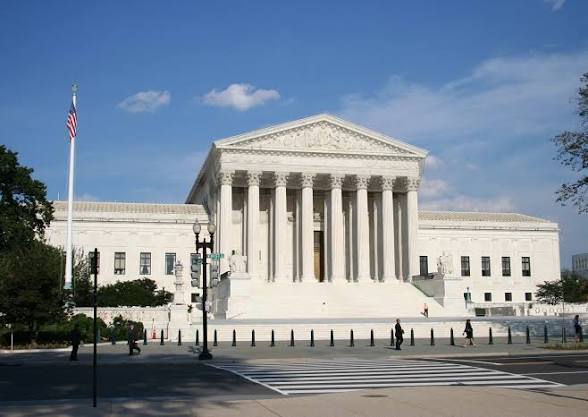
This week, the Supreme Court returned to the bench for the fall session with four oral arguments.
1. Suncor Energy Inc. v. County Commissioners of Boulder County
The first hearing on Monday was for arguments in Suncor Energy Inc. v. County Commissioners of Boulder County, on whether a lawsuit filed in Colorado state court seeking to hold energy companies responsible for their alleged role in climate change can go forward, or whether federal law instead bars such claims. Justice Samuel Alito has recused himself from the dispute and a 4-4 tie would leave the ruling by the Colorado Supreme Court, allowing Boulder’s case to move forward.
Boulder contends that Suncor and ExxonMobil have long deceived the public about the effects of climate change and the role of fossil-fuel products in creating those effects; it also contended that the companies played a role in climate change by producing, refining, and marketing fossil fuels. They are seeking compensation to cover part of the damages incurred as a result of the effects of climate change the companies had allegedly caused.
Representing the energy companies, lawyer Kannon Shanmugam described Boulder’s claims as an “unprecedented effort to use state law to regulate global conduct.” The Constitution, he said, bars the application of state law to “certain inherently federal areas,” and SCOTUS has long held that federal law governs interstate-pollution claims.
Chief Justice John Roberts appeared skeptical, however. He suggested to both Shanmugam and Sarah Harris, the principal deputy U.S. solicitor general who argued on behalf of the Trump administration in support of the energy companies, that it was not uncommon for lawsuits to be based on conduct that occurs outside a state but has broad “effects,” including within the state. He asked Harris “what makes this situation different from those” other cases in which the court allowed lawsuits to proceed in state court.
Harris answered that, unlike those lawsuits, Colorado would ban the production of fossil fuels anywhere in the country. Roberts did not appear to be persuaded.
Justice Elena Kagan also seemed dubious of the energy companies’ arguments. She told Shanmugam that Boulder’s “suit appears to be based on the old 1990s tobacco suits,” as well as more recent lawsuits against opioid manufacturers. “Were those lawsuits also trumped by federal law?”, she asked.
Shanmugam pushed back, describing the tobacco and opioid lawsuits as different. He stressed that the injury at the center of Boulder’s case “is not suffered by the Colorado consumer in the traditional sense.” He then pointed back to the principle that federal law has traditionally applied to claims involving interstate air and water pollution.
Kagan remained doubtful, asking Shanmugam to point to the support for that argument in the text of the Constitution or federal law or in the Supreme Court’s cases. “Where is there anything for that?”
Representing Boulder, lawyer Kevin Russell echoed Roberts’ point, telling the justices that states have long had the power to provide court remedies for injuries that occur within their borders even when the conduct that caused those injuries occurred elsewhere. Applying state law, he said, has never been interpreted as projecting that law nationwide.
Justice Brett Kavanaugh, who was the member of the court most supportive of the energy companies’ position, posed tough questions for Russell. He reference a series of Supreme Court cases that, in his words, “make crystal-clear that interstate air and water pollution are matters for federal law” unless Congress specifies otherwise. In Kavanaugh’s view, those cases mean that state law generally does not apply to claims like Boulder’s, and Congress could believe that interstate-pollution issues are federal issues. Therefore it does not need to pass new legislation to say so explicitly.
Justice Clarence Thomas asked Russell to describe any principles that might restrict whom state and local governments could sue. Several other Justices expressed concerns on opening the floodgates for more cases to be brought around the country.
However the court opts to resolve the case, the justices devoted relatively little time to whether the Supreme Court has the power to consider the energy companies’ appeal at all – a question that the justices had asked the litigants to address when they agreed to take up the case earlier this year. Justices Sonia Sotomayor and Ketanji Brown Jackson appeared the most interested in the question, which would provide an off-ramp that would allow the justices to avoid deciding the merits of the dispute for now, but it received little traction elsewhere.
Justices Sonia Sotomayor and Ketanji Brown Jackson focused heavily on whether the court even has the jurisdiction to step in at this early stage of litigation. The rest of the Justices rejected this attempt at bouncing the case back to the lower courts by using a procedural off-ramp. It is not yet clear how the court will decide this one.
2. Johnson v. United States Congress
Also on Monday, the justices heard argument in Johnson v. United States Congress, on whether a federal district court may hear a constitutional challenge to a law limiting disability benefits for certain incarcerated veterans. The Justices were to decide if the district courts have the jurisdiction to hear the constitutional challenges regarding laws around veterans’ benefits or if those challenges must go through the VA's specialized administrative review process.
The case centers on Section 511(a) of the Veterans’ Judicial Review Act, which addresses the Secretary of Veterans Affairs’ authority over benefits decisions, as well as judicial review of those decisions. Specifically, it states that “[t]he Secretary shall decide all questions of law and fact necessary to a decision by the Secretary under a law that affects the provision of benefits” and that the secretary’s decisions “shall be final and conclusive and may not be reviewed ... by any court,” except in circumstances outlined in other parts of the law.
Section 511(a) – and the VJRA as a whole – is a successor to earlier limits on judicial review of veterans’ benefits decisions that the Supreme Court addressed more than 50 years ago in Johnson v. Robison. Like Section 511(a), these earlier limits described the Department of Veterans Affairs’ decisions on veterans’ benefits as “final and conclusive.” The key difference is that the prior policy more broadly blocked judicial review, stating that “no ... court of the United States shall have power or jurisdiction to review” the VA’s benefits decisions.
In the current case, veteran Floyd Johnson urges the justices to draw the same conclusion about Section 511(a) and hold that his challenge to the constitutionality of a law capping disability benefits for veterans who are incarcerated for more than 60 days may proceed in a federal district court in Florida. Jeffrey Chen, who represented Johnson, told the court that “[t]ext, context, structure, and the government’s own longstanding practice” dictate this result.
Under the VJRA, appeals of benefits decisions go first to the Board of Veterans Appeals, which is within the VA, and then to the Court of Appeals for Veterans Claims and the U.S. Court of Appeals for the Federal Circuit. According to Chen, constitutional challenges like Johnson’s cannot travel this same path, because the BVA has “long disclaimed authority to decide [constitutional] questions.” And to require the BVA to take on that role would be to “empower the inferior officers of the BVA to render final decisions for the executive on whether to disregard acts of Congress,” Chen added.
Kevin Barber, an assistant to the U.S. Solicitor General who argued on behalf of the federal government, appeared to take cues from the justices’ tough questions for Chen, contending that “there’s no basis” for allowing federal district courts to hear certain types of constitutional challenges but not others. While acknowledging that the BVA “in the past has been inconsistent on its authority” to address questions of constitutionality, he asserted that it “can and does” have the authority to answer such questions. To say that it does not, he continued, would be to “compel the VA to enforce a hypothetical benefits statute that was blatantly unconstitutional.”
The Justices pushed back on both parties so it is difficult to predict how the court will decide thecase. Overall, however, more justices seemed to support the government’s position than oppose it.
3. Anderson v. Intel Corporation Investment Policy Committee
On Tuesday, the justices heard argument in Anderson v. Intel Corporation Investment Policy Committee, a dispute under the Employee Retirement Income Security Act on how to handle certain claims that employers have invested employees’ retirement funds imprudently.
The complaint is that Intel’s fiduciaries have bucked traditional practices by investing the funds for their employees’ retirements largely in hedge funds and private equity. Because the Employee Retirement Income Security Act imposes a duty to seek the best possible outcomes with minimal risk for those invested, the lawsuit was formed after lackluster returns. The challenge from the court quickly became whether different portfolios could be judged against the ones used by Intel that were in different asset classes.
The plaintiffs failed to identify a comparable portfolio that was indistinguishable from the one used to be able to prove plausible imprudence, which the Justices repeatedly referred to as comparing apples to oranges. Justice Clarence Thomas said “if you have a fund … that is designed to produce high returns but riskier returns, … you can’t compare that to a fund that is to protect against losses.”
Justice Samuel Alito challenged Matthew Wessler, arguing for the employees, to deny that “you can state a claim by comparing apples and oranges,”
Justice Amy Coney Barrett suggested that “you have … to decide if an apple is an apple? Don’t you have to say, well, it has to be round [and] it has to come from a certain kind of tree?”
Wessler’s complaint mainly focused that the use of hedge funds in general was imprudent and failed to include the performance of other funds as requested.
The court appeared to signal heavily that they will rule in favor of Intel.
4. Department of the Air Force v. Prutehi Guåhan
On Wednesday, the justices heard oral argument in Department of the Air Force v. Prutehi Guåhan, a case on the interaction between two federal environmental laws that arose when the U.S. Air Force applied to renew its permit to dispose of munitions on a beach in northern Guam.
There are two laws at the center of the case. The first, the Resource Conservation and Recovery Act of 1976, also known as RCRA, gives the federal Environmental Protection Agency the authority to regulate hazardous waste. It also allows the EPA to give states (and territories like Guam) the power to administer their own hazardous-waste programs. The second law, the National Environmental Policy Act of 1969, or NEPA, establishes a process for the assessment of the environmental impact of a federal agency’s action, including the preparation of an Environmental Impact Statement before the agency takes “major Federal actions significantly affecting the quality of the human environment.”
In 1982, the Air Force began to dispose of hazardous ammunition, tear gas, and propellants, by detonating them at Tarague Beach, adjacent to Andersen Air Force Base in northern Guam.
In 2021, the Air Force submitted an application to Guam’s EPA to renew the RCRA permit that allows it to detonate munitions on Tarague Beach. A renewed permit would have allowed the Air Force to continue to dispose of munitions there through 2024.
Representing the Air Force, Assistant to the U.S. Solicitor General Sopan Joshi told the justices that “[a] permit application is not final agency action” but instead “a request to someone else to take action” that “triggers a back-and-forth process whose outcome is, by definition, a moving target until a decision on the permit is issued.” He added that “RCRA is a comprehensive statute specifically targeting hazardous waste and specifically specifying which environmental review must occur at each step of a reticulated permit process.” Prutehi Guåhan, Joshi said, cannot simply impose all of NEPA’s requirements on an RCRA application, because doing so would be “inconsistent with RCRA’s specification of when each of those requirements should occur through the permitting process.” Essentially Joshi is arguing that because the RCRA has specific step-by-step rules, the Air Force cannot be expected to comply with NEPA's broader rules at the start of the application process.
Caroline Flynn, representing Prutehi Guåhan, countered that NEPA “is meant to be harmonized with other environmental laws,” like RCRA. “It is what agencies call an umbrella law,” she said: “It is meant to consolidate and streamline all required environmental analysis at an early juncture to ensure a better decision and better planning.” In short, the two laws Re meant to be used together during the planning and application process to ensure compliance.
Justice Katanji Brown-Jackson stated “we don’t even know in this situation what the final terms” of the Air Force’s permit will be. And questioned whether this case was ahead of itself as the application hadn't been ruled upon.
Justice Elena Kagan also expressed skepticism, telling Flynn that “there is a gigantic contingency here and the permit might not be issued in the way that the Air Force would like it to be issued.”
Other Justices expressed concern that, if the Air Force’s application to renew its RCRA permit is not a final action, groups like Prutehi Guåhan might face difficulty in challenging the Air Force’s decision to continue to detonate hazardous wastes at Tarague Beach.
The Justices did not signal which way this would fall.
All of these cases are under review by the court and decisions can be expected sometime this winter.