Supreme Court Weekly Review: Beaird v. United States & Salazar v. Paramount Global
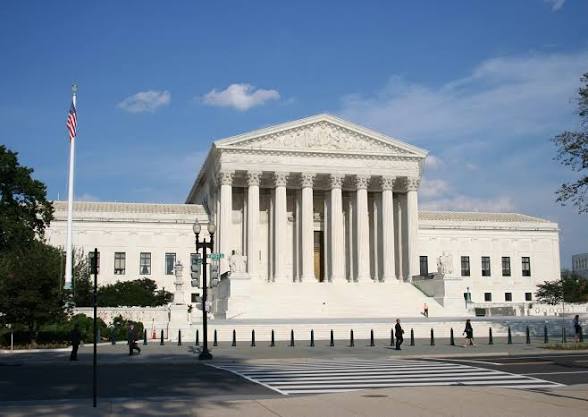
This week, the Supreme Court heard two arguments, Beaird v. The United States and Salazar v. Paramount Global.
Beaird v. The United States
In October 2022, officers saw Kendrick Beaird point a firearm at another person in an abandoned fast-food restaurant. After arresting Beaird, officers found that his gun, a Glock, had a magazine capable of holding 17 rounds. Because Beaird had four prior felony convictions, he was charged with and pleaded guilty to being a felon in possession of a firearm, in violation of 18 U.S.C. § 922(g)(1). That offense is subject to the guideline in Section 2K2.1(a)(3), which recommends a higher sentence if the defendant’s offense “involved” a “semiautomatic firearm that is capable of accepting a large capacity magazine.”
The question at hand then becomes whether a magazine that holds 17 rounds is a “large capacity magazine.” The text of Section 2K2.1 does not define that phrase, but the commentary to the guideline from the US Sentencing Commission does, defining a large capacity magazine as including “a magazine … that could accept more than 15 rounds of ammunition.”
The case Stinson v. The United States set a precedent that analyzed the deference that courts owe to an agency’s interpretation of its own regulations and applied those standards to the commission’s commentary interpreting a sentencing guideline. The court held that the US Sentencing Commission is allowed to “interpret or explain” a guideline unless it violates the Constitution or a federal statute.
The addition of the “large capacity magazine" changes a 51-63 month sentence to 63-78 months. Beaird was ultimately given 72 months in prison by a district court; he hopes to have his sentence reduced.
Key Arguments & Court Observations
- Beaird's Defense: Beaird's legal team argued that 17-round magazines are now common in the commercial market and that the commentary by the US Sentencing Commission improperly expands the federal statute. They also argued that the rule of lenity is one of the paths to provide relief, as the rule dictates that if the statutes or their interpretation are vague, the case must be resolved in favor of the defendant.
- The Government's Position: The government argued that the US Sentencing Commission commentary was part of a broader, unified regulatory structure and meant to be used to specify the criminal statute outlined in 18 U.S.C.
- The Justices' Reaction: The Justices pushed back on the sweeping attempt to strip authority from the US Sentencing Commission to interpret the statutes. They also discussed how to come to a decision regarding “genuine ambiguity" to follow the rule of lenity.
Outlook: The Justices seem unlikely to overturn Beaird's sentence extension.
Salazar v. Paramount Global
- In 2022, Michael Salazar subscribed to an email newsletter distributed by 247Sports.com, a website owned by Paramount that covers college sports recruiting. Salazar says that while he was logged into his Facebook account, he watched videos on the 247Sports.com site. Using coding known as a Pixel that it had installed on 247Sports.com, and without Salazar’s consent, Paramount then provided Facebook with information about the videos that Salazar had watched on the site.
- Salazar's claim is that Paramount violated the Video Privacy Protection Act, which bars a “video tape service provider” from “knowingly disclos[ing], to any person, personally identifiable information concerning any consumer of such provider.” Salazar asked a federal court in Nashville for a $2,500 award, which would have been the maximum amount available. The same amount was asked for all members of the class action lawsuit he was involved with.
- US District Court Judge Eli Richardson threw out the class action, citing that Salazar was not a “consumer,” because a “consumer” must be “‘a subscriber of goods and services in the nature of audio-visual content.’” Because the 247Sports.com newsletter was not “audio-visual content,” Richardson reasoned, Salazar could not be a “subscriber.” The Court of Appeals for the 6th Circuit upheld Judge Richardson's ruling.
- Paramount's Defense: Representing Paramount, Paul Clement argued that since the streaming service doesn't explicitly provide video tapes, the VPPA does not apply.
- Conservative Considerations: The conservative members on the court seemed to at least consider Clement's argument, though Justice Brett Kavanaugh also expressed concerns about “opening the floodgates" to further lawsuits.
- Proposed Remedies: Justice Kavanaugh and Justice Elena Kagan did assert that the easiest way to rectify the situation would be for Paramount to put a stop to selling user information and to ask for consent from the consumer before disclosing any information.
- Pushback on Line-Drawing: Justice Ketanji Brown Jackson told Clement that he had “a line-drawing problem.” The point of the VPPA, she said, “was the unlawful disclosure without consent of personally identifying information.” But under Paramount Global’s interpretation, she continued, the application of the statute would hinge on “what particular item the consumer purchased” from the video tape service provider. “And I don’t understand why that should be the dividing line or why that makes any sense in this concept.”
Outlook: Overall, the Justices seemed poised to rule in favor of Salazar as most seemed to agree that the line Paramount was attempting to draw was frivolous.