The U.S. Army Is Practicing Mass Battlefield Burials. What Kind of War Is It Preparing For?
The military is testing how to temporarily bury thousands of fallen service members in a single day. The exercise raises serious questions about how the Pentagon envisions the next major American war.
The United States military is preparing for a possibility most Americans would rather not imagine.
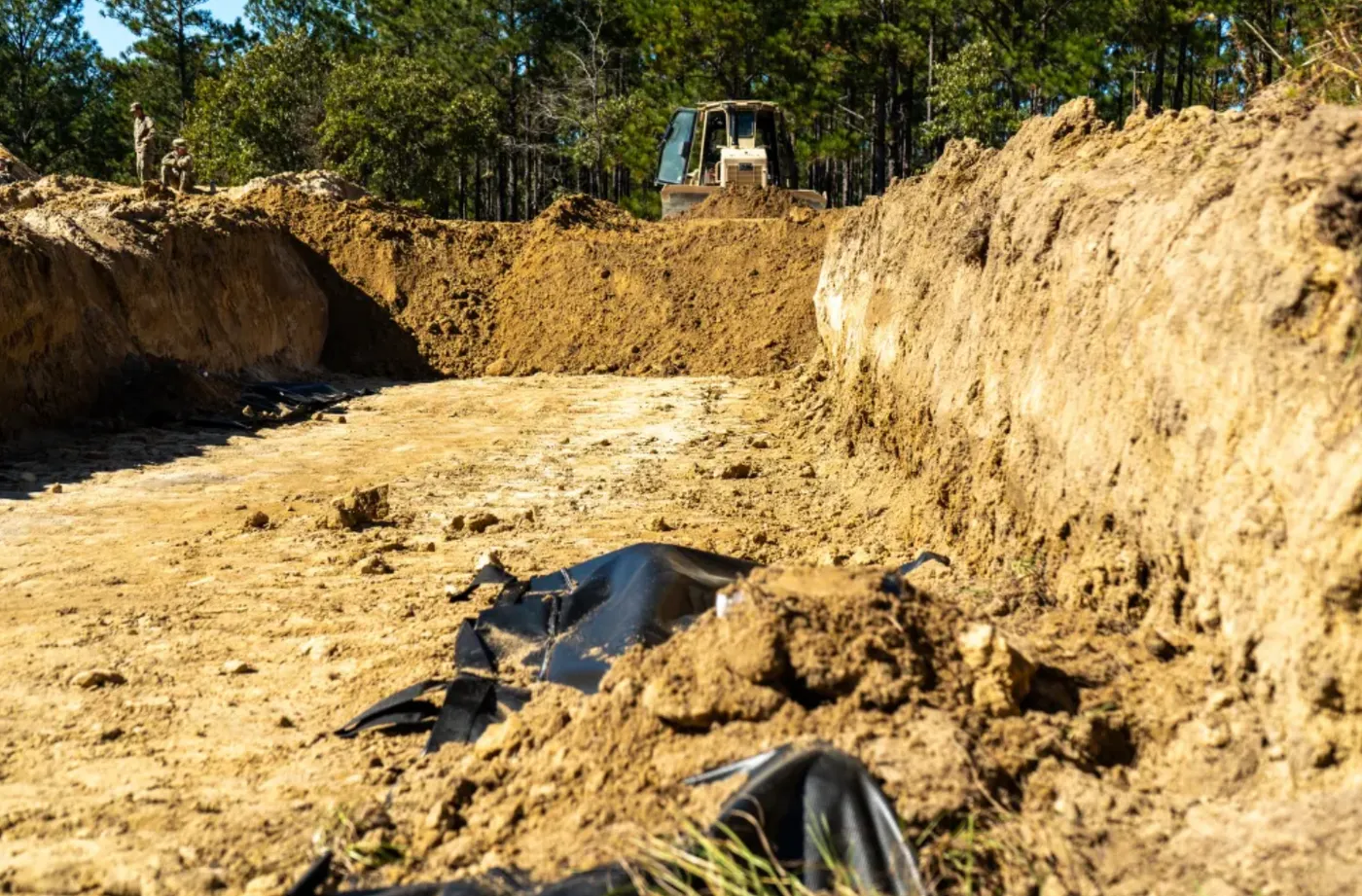
In North Carolina, U.S. Army soldiers recently practiced digging enormous battlefield burial trenches, testing how quickly military engineers could temporarily bury fallen service members during a large-scale conflict.
According to an official Army announcement published October 26, military planners determined that a properly equipped engineering company could potentially prepare and close burial trenches for 2,400 human remains in just 24 hours.
Two thousand four hundred.
In one day.
The operation, known as Operation Dragon Covenant, involved military engineers, fatality management specialists, preventive medicine personnel, and chaplains.
The stated objective was to prepare for circumstances in which American service members die in such large numbers, or under such dangerous conditions, that their remains cannot immediately be transported home.
The Army says this kind of large-scale temporary battlefield burial has not been carried out by American forces since the Korean War.
That alone should get our attention.
But the larger question is one the American public deserves to have answered.
What kind of war is the Pentagon preparing for?
🔴 An Exercise That Should Get America's Attention
The exercise took place near the St. Mere Eglise Drop Zone at Fort Bragg, North Carolina.
Soldiers from the 3rd Corps Sustainment Command and the 20th Engineer Brigade used heavy construction equipment to excavate and refill temporary burial trenches.
These were not actual battlefield casualties. The Army used simulated skeletal remains and sealed water containers to test whether its methods would preserve bodies for eventual recovery and identification.
Engineers discovered that D6 bulldozers could excavate trenches accommodating 20 remains in approximately 75 minutes.
Using those results, military planners calculated that an engineering company operating eight bulldozers and four additional excavating vehicles could potentially prepare and close trenches for 2,400 remains per day under continuous operations.
The figure is an engineering estimate, not a prediction of casualties or a demonstrated daily burial total.
Nevertheless, the scale of the planning is extraordinary.
The Army is developing procedures for a battlefield where the number of dead could overwhelm the military's ability to evacuate remains through conventional channels.
That is the scenario being studied.
And it deserves public examination.
🔴 Why Is the Military Revisiting This Now?
For much of the past two decades, American military operations in Iraq and Afghanistan relied on systems that allowed fallen service members to be transported relatively quickly to the United States.
Those systems depended on transportation networks, operational access, and the ability to move personnel and equipment through contested areas.
A future war against a powerful military opponent could look dramatically different.
Airspace might be contested. Supply routes could be interrupted. Medical facilities could become overwhelmed. Transportation aircraft might be unavailable or unable to operate safely.
Under those circumstances, temporary battlefield burial could become necessary.
This is part of what military planners call large-scale combat operations.
Rather than fighting smaller insurgent forces, the United States could face a military opponent capable of inflicting significant losses across an extended battlefield.
Potential conflicts involving powerful states, including China or Russia, are among the broader strategic scenarios that have shaped American military planning.
However, the Army's announcement does not identify either country as the specific reason for Operation Dragon Covenant.
That distinction matters.
There is no verified evidence that this exercise signals an imminent American war.
What it demonstrates is that the military is actively developing capabilities for conditions that could arise during a particularly destructive conflict.
And Americans have every reason to ask why those capabilities are receiving attention now.
🔴 Preparing for a Different Kind of Casualty Crisis
One of the most revealing elements of Operation Dragon Covenant was not the excavation itself.
It was the involvement of military chaplains.
According to the Army, approximately 130 religious support personnel participated in training designed to address the spiritual and psychological consequences of large-scale battlefield deaths.
Military officials acknowledged that traditional individual religious services might become impossible during continuous burial operations.
In a high-intensity conflict, personnel could be forced to manage large numbers of remains without knowing the identities or religious backgrounds of the deceased.
Chaplains explored procedures for consecrating burial areas while preserving the dignity of fallen service members.
The Army also identified the possibility that religious support teams could experience severe physical and emotional exhaustion within four to six hours of high-casualty operations.
Think about what that means.
The military isn't simply studying how quickly trenches can be excavated.
It is examining how human beings might cope with the responsibility of temporarily burying large numbers of fellow service members during an ongoing war.
These are serious preparations for an exceptionally grim possibility.
🔴 What the Army Actually Says
In its official announcement, the Army explained that Operation Dragon Covenant was designed to test procedures for preserving remains so they could eventually be recovered, identified, and returned to their families.
The exercise also exposed shortcomings in existing military guidance.
For example, engineers discovered that previously established trench spacing did not adequately accommodate modern bulldozers.
The Army intends to incorporate those findings into updated fatality management doctrine.
That may sound like a technical detail.
But it demonstrates that the military is doing more than conducting a symbolic training exercise.
It is updating operational procedures, equipment requirements, and personnel responsibilities for the possibility of large-scale battlefield deaths.
The Army has also announced plans for a third phase of the exercise in spring 2027.
That phase is expected to incorporate security teams, medical facilities, mortuary affairs personnel, and operations conducted under blackout conditions.
In other words, the Army intends to test a more complete system for managing casualties in dangerous battlefield environments.
🔴 What This Does Not Prove
There is an important distinction between military preparedness and evidence of an impending conflict.
Armies routinely prepare for scenarios they hope never occur.
Training for battlefield fatalities does not establish that military leaders expect thousands of American service members to die in the immediate future.
It also does not prove that the Trump administration has authorized a new war or that these burial sites are intended for civilian populations.
The 2,400-remains figure represents a projected operational capacity under specified conditions, not an expected daily death toll.
Presenting those possibilities as established facts would mislead readers.
But acknowledging those limitations does not make the exercise insignificant.
The question is not whether the Army has secretly announced a coming war. It hasn't.
The question is what changes in military planning have made these particular capabilities important enough to test and update.
🔴 Questions the Pentagon Should Answer
Operation Dragon Covenant raises several questions that deserve direct answers from military leadership.
1. What threat assessments informed this exercise?
Was the training initiated as part of a broader shift toward preparing for high-casualty conflicts, or was it primarily intended to address longstanding gaps in military doctrine?
2. Which operational scenarios are driving the planning?
Is the Army preparing for particular geographic theaters, or developing capabilities intended to apply across multiple potential conflicts?
3. How would the military protect identification and accountability?
In circumstances involving thousands of temporary burials, what safeguards would ensure that every fallen service member could eventually be identified and returned home?
4. What would this mean for military families?
How would the Pentagon communicate with families if battlefield conditions prevented the immediate recovery or repatriation of their loved ones?
5. How does this fit into broader Pentagon planning?
Are other branches of the military conducting comparable exercises, and how are these procedures being incorporated into joint operations?
These questions are not accusations.
They are questions of public accountability.
Americans fund the military. American families bear the consequences of war.
They deserve to understand the risks their government is preparing to confront.
🔴 The Human Cost Behind the Numbers
Military planning documents can make extraordinary human suffering sound routine.
Capacity estimates. Operational requirements. Engineering timelines. Fatality management procedures.
But behind every hypothetical casualty is a person.
A parent. A child. A spouse. A friend.
Someone who may have enlisted believing they would serve their country and eventually return home.
Preparing to treat fallen service members with dignity is an essential military responsibility.
The Army deserves scrutiny for its planning, but the soldiers and chaplains working to preserve and identify the dead are performing an important duty.
The larger responsibility belongs to the political and military leaders whose decisions determine when American troops are sent into combat.
Because there is something profoundly unsettling about a country preparing for the logistical demands of burying thousands of its service members.
Especially when the public may have little understanding of the scenarios driving that preparation.
🔴 Americans Deserve Answers Before the Next War, Not After
The United States has spent decades fighting wars that have cost lives, destabilized communities, and left lasting consequences for military families.
Now, its Army is revisiting procedures associated with an earlier era of large-scale warfare.
The military says the objective is to ensure fallen soldiers can eventually be identified and returned home.
That is a legitimate and necessary responsibility.
But it is also a reminder of what a major war could demand from the country.
The next conflict involving American forces might not resemble the wars many Americans have grown accustomed to watching from a distance.
It could involve contested airspace, disrupted supply lines, overwhelmed medical systems, and casualty levels that existing evacuation procedures cannot manage.
That is the possibility this exercise is designed to address.
And it raises a question that deserves more than a routine military press release.
If the Pentagon is preparing for a war devastating enough to require temporary battlefield burial operations on this scale, what is it doing to prevent such a war from happening in the first place?
The American people deserve an answer.
And they deserve it before another generation is asked to pay the price.