They Put His Name on It. Tonight, the Courts Made Them Take It Down.
Cup of Culture | SeanBartley.substack.com
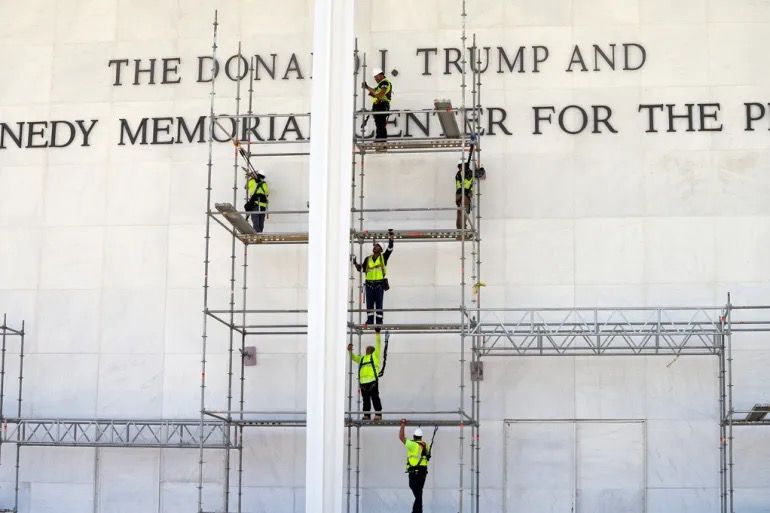
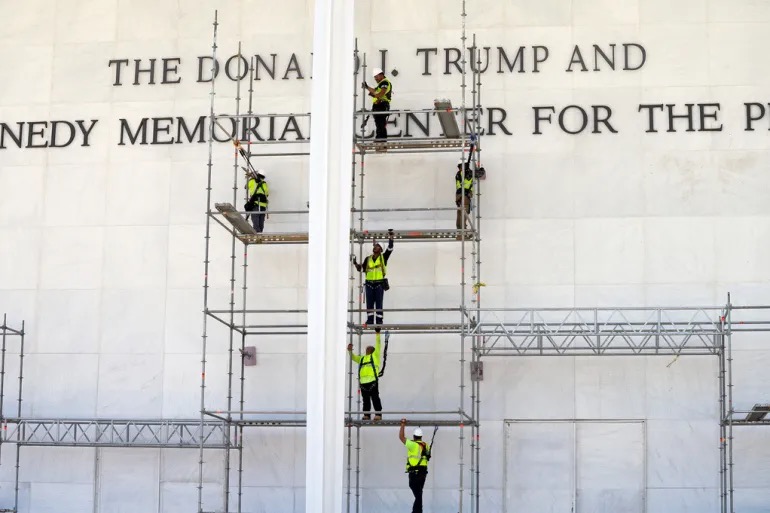
Tonight, workers in Washington are on scaffolding outside the Kennedy Center — one of the most iconic arts institutions in America — removing Donald Trump’s name from the building.
Not because he lost an election. Not because his poll numbers are bad. Because two federal courts, on the same day, told him the law doesn’t bend for his ego.
And that matters more than it might seem.
How We Got Here
The Kennedy Center was created by an act of Congress in 1964, named after John F. Kennedy following his assassination. It’s a living memorial. A national institution. The kind of thing that belongs to the public, not any single president.
Trump apparently didn’t get that memo.
Just a month into his second term, he fired most of the sitting Board of Trustees and replaced them with hand-picked loyalists. That new board promptly elected Trump as chairman. And in December 2025, that same board voted — “unanimously,” they said — to rename the building The Donald J. Trump and The John F. Kennedy Memorial Center for the Performing Arts. Workers slapped new lettering on the facade within days.
Artists pushed back immediately. Dozens canceled performances. Country singer Kristy Lee put it plainly: “When American history starts getting treated like something you can ban, erase, rename, or rebrand for somebody else’s ego, I can’t stand on that stage and sleep right at night.” Shonda Rhimes resigned from the board. Issa Rae pulled out of a sold-out show. The list kept growing.
But the administration dug in. Richard Grenell, Trump’s appointed president of the newly renamed center, threatened a performer who canceled with $1 million in damages, calling the cancellations acts of “far left political activists.”
That was the posture: we renamed it, we run it, deal with it.
The Courts Said Otherwise
Representative Joyce Beatty, an Ohio Democrat who holds an ex officio seat on the Kennedy Center board, filed suit to stop the renaming. On May 29, U.S. District Judge Christopher Cooper ruled in her favor — and he didn’t mince words.
“Congress gave the Kennedy Center its name, and only Congress can change it.”
Cooper set a deadline: June 12. Fourteen days to remove the name.
He also blocked the administration’s plan to shutter the center for two years of renovations — a move he described as an “ill-informed” and “seemingly preordained” decision by the Trump-stacked board.
The administration didn’t comply quietly. They asked Cooper to pause his own ruling while they appealed. He denied it, noting the center had already started removing Trump’s name from its website and branding, which, as he put it, “undermines the notion that Defendants face irreparable harm in complying with the order in full.”
Then the DOJ ran to the appeals court with an emergency request. The three-judge panel on the D.C. Circuit denied that too — ruling just hours before tonight’s midnight deadline.
So tonight, the scaffolding went up. The name is coming down.
Why This Is Bigger Than a Name
Here’s what I want you to hold onto: this wasn’t about aesthetics. It wasn’t about whether Trump’s name sounds good next to Kennedy’s. It was about whether a president can unilaterally claim national institutions as personal property.
The answer, at least tonight, is no.
Trump has spent his second term treating the capital like a private development project. He renamed the Gulf of Mexico. He’s pushed for a triumphal arch near Arlington National Cemetery. He tried to close a cultural institution that belongs to the American people for two years — not to restore it for the public, but to reshape it in his image.
The Kennedy Center was supposed to be easy. He controlled the board. He controlled the management. He controlled the signage crew. The only thing he didn’t control was the law — and that’s exactly what stopped him.
A congressional Democrat sued. A federal judge held firm. An appeals court backed him up. And thousands of people gathered outside the Kennedy Center today, taking pictures and cheering as the scaffolding went up.
That’s not nothing. In an era when it can feel like the walls only ever move in one direction, this is a wall that moved back.
What Comes Next
The DOJ is still appealing. The three-judge panel left the door open: if the appeal succeeds, Trump’s name could theoretically go back up. So don’t count this as a permanent win — count it as a proof of concept.
The courts work when people use them. Artists pushing back matters. Elected officials filing suit matters. Crowds showing up to document the moment matters.
None of that is guaranteed to hold forever. But tonight, it held.
The Kennedy Center belongs to the public. And tonight, the courts reminded everyone of that — including the president.
Sean Bartley is a Seattle-based journalist and the founder of Cup of Culture. If this kind of independent progressive coverage matters to you, consider becoming a paid subscriber at SeanBartley.substack.com.