Trump Tells Minnesota to “Fight Back” Against Somali Immigrants in Alarming Presidential Statement
The president singled out an entire immigrant community, accused it of widespread criminality, and suggested the federal government could intervene in Minnesota.
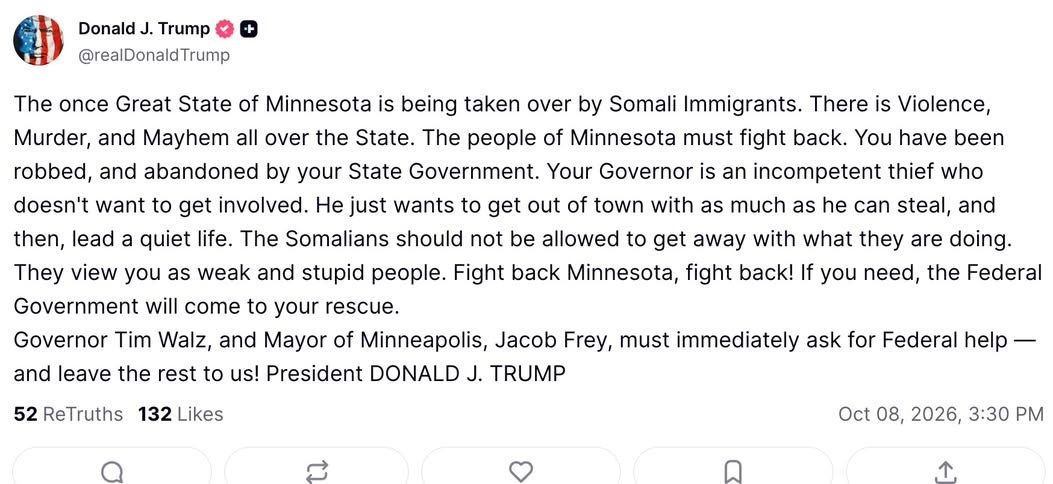
President Donald Trump has issued an alarming statement targeting Minnesota’s Somali immigrant community, telling residents to “fight back” while portraying an entire population as a threat to the state.
In a statement dated October 8, Trump claimed Minnesota was being “taken over by Somali Immigrants” and described the state as suffering from widespread violence, murder, and chaos.
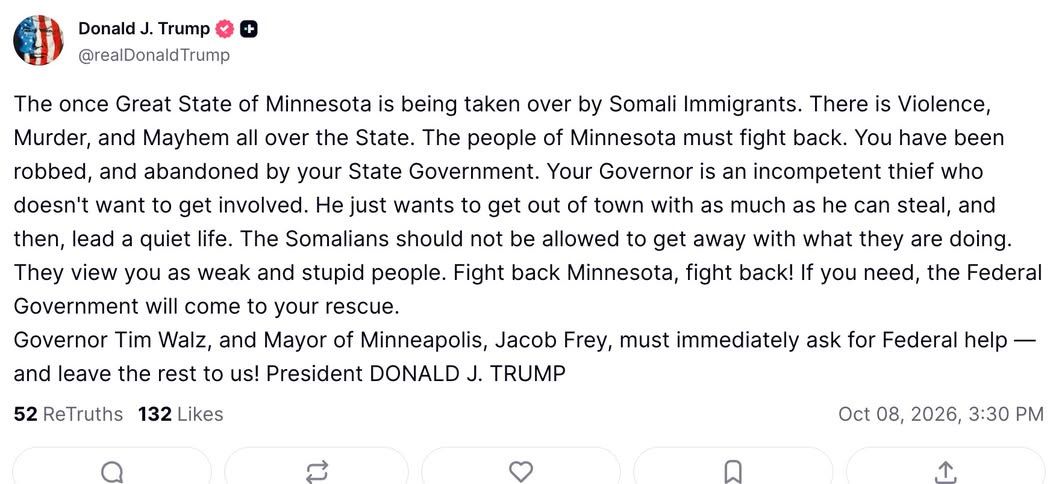
He offered no supporting evidence for those sweeping accusations in the statement.
But the most disturbing language came when Trump appeared to encourage Minnesotans to take matters into their own hands.
“The people of Minnesota must fight back,” Trump wrote.
He later repeated the message: “Fight back Minnesota, fight back!”
These are not the words of an ordinary political disagreement. They are the words of a sitting president singling out an ethnic and immigrant community, portraying its members as dangerous, and encouraging confrontation.
An Entire Community Made Into a Target
Minnesota is home to one of the largest Somali communities in the United States. Somali Americans are business owners, healthcare workers, educators, students, parents, and neighbors. Many are American citizens.
Trump’s statement made no meaningful distinction between people accused of committing crimes and the broader Somali population.
Instead, he declared that “The Somalis should not be allowed to get away with what they are doing.”
That distinction matters.
Criminal conduct should be investigated and prosecuted based on evidence and individual responsibility. Ethnicity and national origin are not evidence of criminality.
When the president treats an entire community as collectively responsible for alleged wrongdoing, he risks encouraging discrimination, harassment, and violence against people who have committed no crime.
The Threat of Federal Intervention
Trump’s statement went beyond inflammatory rhetoric.
“If you need, the Federal Government will come to your rescue,” he wrote.
He also demanded that Minnesota Governor Tim Walz and Minneapolis Mayor Jacob Frey immediately request federal assistance and “leave the rest to us.”
The statement did not explain what federal intervention would involve, which agencies would participate, or what legal authority the administration intended to invoke.
Those unanswered questions are significant.
Federal intervention in a state raises serious questions about constitutional authority, local control, civil liberties, and the potential use of federal law enforcement against communities already facing political hostility.
A president cannot simply declare an immigrant population a threat and treat that declaration as a substitute for evidence or legal authority.
Dangerous Rhetoric From the Highest Office
The United States has a long history of political leaders using fear of immigrants and minority communities to justify discriminatory policies.
The pattern is familiar: portray a community as dangerous, insist that government officials have failed to protect the public, and present extraordinary federal action as the only solution.
Trump’s statement follows that rhetorical pattern.
His repeated demands that Minnesotans “fight back” are especially concerning because the statement does not clarify whether he is calling for political action, law enforcement cooperation, or direct confrontation.
That ambiguity is dangerous when the target is an identifiable community.
Political leaders have a responsibility to reduce the risk of violence, not amplify hostility toward entire populations.
Minnesota Deserves Facts, Not Fear
If the Trump administration has evidence of specific criminal activity, it should present that evidence and allow the justice system to respond.
What it should not do is use allegations of crime to cast suspicion on thousands of people because of their ancestry or immigration background.
Somali Minnesotans are not collectively responsible for the actions of individuals.
They are part of Minnesota.
And they deserve the same constitutional protections, dignity, and safety as everyone else.
The president’s job is to protect the public, not turn one community against another.
The question now is whether Minnesota’s elected officials, civil rights organizations, and national political leaders will forcefully reject this rhetoric before it translates into further threats against the people being targeted.
Because when a president tells Americans to “fight back” against an entire community, those words deserve scrutiny, accountability, and an unequivocal rejection of collective blame.
Cup of Culture will continue following developments surrounding the administration’s statements and any proposed federal intervention in Minnesota.