Trump Threatens to Blame Iowa Governor-Elect for Deaths as Military Explosives Detonation Faces Court Challenge
The president says the Army must destroy nearly five tons of unstable explosives, but environmental groups warn the operation could spread toxic lead contamination across communities in Iowa and Illinois.
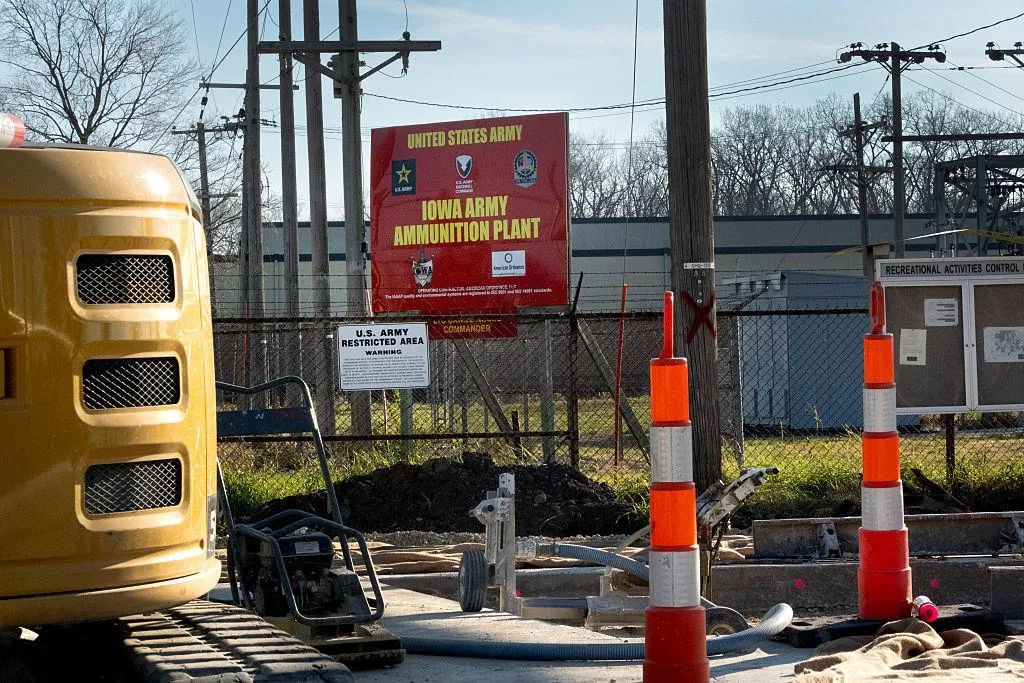
President Donald Trump announced Monday that he has ordered the U.S. military to delay a controversial explosives detonation in Iowa until a federal appeals court and Democratic Governor-elect Rob Sand agree to allow the operation to proceed. Trump also warned that he would hold Sand responsible for any deaths or destruction resulting from the hazardous materials if the operation is blocked.
The announcement adds another layer of political conflict to an already contentious environmental and public safety emergency involving approximately 68 barrels of deteriorating lead azide stored at the Iowa Army Ammunition Plant in Middletown.
The Army has been preparing to destroy nearly five tons of the highly unstable explosive compound, arguing that deteriorating storage conditions and falling temperatures could trigger an uncontrolled explosion.
Environmental organizations, however, have challenged the proposed operation in federal court, warning that detonating the material could release dangerous lead contamination into surrounding communities.
Now, with a court battle underway and residents demanding answers, Trump is placing responsibility for the outcome on Iowa's incoming Democratic governor.
Trump Issues Warning to Governor-Elect Rob Sand
In a statement published Monday, Trump described the situation as a military cleanup operation involving explosives he claimed were improperly stored during the Obama administration in 2009.
Trump asserted that military experts believe the materials could explode without warning and that a controlled detonation represents the safest available option.
He also announced that he had ordered the military not to proceed until both the U.S. Court of Appeals for the Eighth Circuit and Governor-elect Sand agree.
Trump warned that if approval is withheld, he would hold Sand responsible for deaths or destruction caused by the hazardous materials.
The statement represents a significant development because Sand, who has not yet assumed office, is being publicly assigned responsibility by the president for a federal military operation and its potential consequences.
Trump's statement does not establish that Sand has the legal authority to approve or prohibit the detonation. Nor does it establish that the governor-elect would bear legal responsibility for an accidental explosion.
It remains unclear how Trump's newly announced conditions will affect the Army's previously scheduled operation.
What Is Happening at the Iowa Army Ammunition Plant?
The controversy centers on lead azide, an extremely sensitive explosive compound commonly used in ammunition detonators.
Federal officials say 68 barrels of degraded material were identified at the Middletown facility in March.
The Army maintains that the compound has deteriorated to the point that movement, temperature changes or other disturbances could cause an accidental explosion.
The Justice Department has argued that emergency conditions justify proceeding with a controlled detonation even without the environmental permit currently blocked by the courts.
Before Trump's latest statement, the Army had rescheduled the operation for Wednesday, November 25, citing more favorable weather conditions and additional time to establish safety measures.
The federal government argues that delaying destruction of the material could create an even greater danger to nearby communities.
But the proposed solution presents serious environmental concerns of its own.
Environmental Groups Warn of Toxic Lead Exposure
The Iowa Environmental Council and Sierra Club have challenged the federal government's authorization for the detonation.
Their concerns center on the potential release of airborne lead particles, which could contaminate surrounding neighborhoods, agricultural land and water resources.
Environmental advocates have warned that a plume of lead-containing dust could travel as far as 100 miles under certain conditions.
That distance is a potential exposure scenario, not a confirmed prediction of where contamination will occur.
Lead is a toxic heavy metal particularly dangerous to children and pregnant people. Exposure can cause neurological damage and other long-term health consequences.
Federal health authorities have repeatedly emphasized that no safe blood lead level has been identified in children.
Residents near the ammunition plant have been advised to take precautions, including remaining indoors, closing windows and limiting the circulation of outside air if the detonation occurs.
The situation has also raised concerns across the Mississippi River in Illinois.
Illinois officials have demanded additional information about potential airborne contamination, environmental monitoring and the federal government's plans to protect affected communities.
Federal Appeals Court Intervenes
On November 19, the Eighth Circuit temporarily blocked the Environmental Protection Agency permit authorizing the detonation while legal challenges proceeded.
The Justice Department subsequently argued that an emergency exception under federal environmental law would allow the Army to conduct the operation without relying on the suspended permit.
Environmental organizations have challenged that approach, arguing that the government must demonstrate the necessity of bypassing ordinary environmental protections.
The dispute raises questions about the limits of federal emergency authority, the adequacy of public notice and the government's responsibility to evaluate potential environmental consequences before conducting a hazardous operation.
Trump's Monday announcement appears to introduce additional political conditions into that ongoing legal dispute.
Whether the Army will continue pursuing emergency authority or await further judicial action remains unresolved.
A Public Safety Emergency Becomes a Political Confrontation
The central question is not whether deteriorating explosives present a danger. Federal officials and environmental advocates both recognize that the materials require a safe resolution.
The disagreement concerns how that danger should be addressed and whether the government's proposed detonation adequately protects surrounding communities.
The Army maintains that a controlled explosion offers the lowest immediate risk.
Environmental groups argue that federal agencies have not sufficiently demonstrated that alternative methods were considered or that residents will be adequately protected from toxic contamination.
Trump's decision to single out Sand introduces a separate issue: the president is threatening to assign responsibility for a potential disaster to an incoming governor before the legal dispute has been resolved.
There is also an unresolved question about the administration's own role in managing the situation.
Federal officials have acknowledged that planning for the detonation began in March, months before the emergency reached its current stage.
That timeline raises legitimate questions about why nearby communities received limited advance notice and why the operation became the subject of urgent litigation so close to its scheduled execution.
For residents of Iowa and Illinois, those questions are not abstract political disputes. They concern the safety of their homes, families, farms and communities.
What Happens Next?
The Army's most recently reported detonation date was Wednesday, November 25, although Trump's latest announcement creates uncertainty about whether that schedule remains in effect.
The Eighth Circuit has not been shown to have lifted its stay, and the administration's assertion of emergency authority remains contested.
It is also unclear whether Governor-elect Sand has responded to Trump's statement or whether federal officials have formally requested his approval.
For now, nearly five tons of unstable explosives remain at the center of a dispute involving the White House, federal courts, environmental organizations and communities facing potentially serious consequences.
The immediate priority is determining how to eliminate the danger without creating another one.
Cup of Culture will continue monitoring the legal proceedings, federal military announcements and public safety guidance as this story develops.
Sources: Reuters, November 22–23, 2026; Associated Press, November 21–23, 2026; U.S. Army joint statement, November 20, 2026; Illinois Environmental Protection Agency, November 20, 2026; President Trump's November 23 public statement.